Vulnerability Intelligence Is a Prioritization Problem, Not a Feed Problem
- Introduction
- The Feed Trap: More Data Does Not Equal Better Decisions
- Start with a Triage Contract
- Use NVD for Baseline Metadata, Not Final Priority
- Use CISA KEV as a Fast Escalation Signal
- Build a Context-Weighted Priority Model
- Prevent Alert Fatigue with Suppression and Routing Rules
- AWS-Centric Implementation Pattern
- Where VulnDB-Style Intelligence Fits
- Implementation Roadmap
- Best Practices for Sustainable Vulnerability Intelligence
- Related Articles
- Additional Resources
- Conclusion
Introduction
Most vulnerability programs do not fail because they lack feeds. They fail because every new feed adds more work than the team can absorb.
NVD entries, vendor advisories, CISA Known Exploited Vulnerabilities (KEV), scanner findings, cloud posture alerts, container image results, software bill of materials (SBOM) data, and threat intelligence feeds all describe pieces of the same problem. But without a prioritization model, they become an expensive notification system: more tickets, more dashboards, more exceptions, and less confidence about what must be fixed first.
Vulnerability intelligence should answer one operational question:
Which vulnerabilities create the most plausible risk to the systems that matter right now?
That is a prioritization question, not a feed aggregation question. A useful vulnerability-intelligence program combines public sources such as NVD and CISA KEV with internal context: asset criticality, internet exposure, compensating controls, exploit maturity, ownership, business function, and remediation path. The result is fewer alerts, clearer service-level objectives, and better conversations between security, engineering, and operations.
Current Landscape Statistics
- 25,000+ CVEs are published annually in recent years, and the volume continues to grow across operating systems, applications, cloud services, and open-source dependencies.
- 1,000+ entries are listed in the CISA KEV catalog, representing vulnerabilities with confirmed exploitation in the wild.
- Single CVSS scores are insufficient for operational triage because they describe technical severity, not whether the vulnerable software is present, exposed, exploitable, or business-critical in your environment.
- Alert fatigue is a security risk: when every vulnerability looks urgent, teams either ignore the queue or create informal prioritization rules that are hard to audit.
- Context-rich programs reduce noise by suppressing non-applicable findings, escalating externally exposed critical assets, and routing work directly to accountable owners.
The Feed Trap: More Data Does Not Equal Better Decisions
Adding another vulnerability feed feels productive because it increases visibility. The problem is that visibility without decision logic increases cognitive load.
A typical security team may receive vulnerability signals from:
- NVD CVE records and CVSS metadata
- CISA KEV entries for known exploited vulnerabilities
- Vendor advisories and emergency bulletins
- Container and package scanners
- Endpoint detection and response tooling
- Cloud security posture management findings
- Web application scanners
- Asset inventory systems
- SBOM and dependency graphs
- Threat intelligence reports
Each source is useful. None of them is sufficient by itself.
NVD can tell you that a vulnerability exists and provide standardized scoring metadata. CISA KEV can tell you that a vulnerability has been exploited in the wild. A scanner can tell you that a package or configuration appears vulnerable. Your asset inventory can tell you where the affected technology exists. Your cloud telemetry can tell you whether the system is internet-facing. Your change-management data can tell you who owns it and whether a patch is deployable.
The mistake is treating all of those signals as separate queues. That creates duplicate work and competing definitions of urgency. A better model normalizes the signals into one decision pipeline.
Start with a Triage Contract
Before adding automation, define a triage contract that everyone can understand. The contract should describe how vulnerability intelligence becomes action.
At minimum, document:
- Intake sources — Which sources are authoritative for CVE metadata, exploitation status, asset inventory, and ownership?
- Applicability rules — How do you prove a finding is relevant to an asset, package, image, runtime, or exposed service?
- Priority model — Which factors can raise or lower urgency?
- Service-level objectives — How quickly must each priority level be remediated or mitigated?
- Exception rules — Who can accept residual risk, for how long, and with what compensating controls?
- Feedback loop — How are false positives, duplicate tickets, and stale ownership records corrected?
A triage contract prevents the vulnerability program from becoming a personality-driven escalation process. It also makes automation safer because the logic is explicit before it is encoded into workflows.
Use NVD for Baseline Metadata, Not Final Priority
The National Vulnerability Database is a foundational source for CVE enrichment. It provides standardized identifiers, descriptions, references, affected products through Common Platform Enumeration (CPE), and CVSS scoring. NVD is excellent for baseline metadata.
But NVD should not be the last word on urgency.
CVSS answers, “How severe could this vulnerability be under standardized assumptions?” Operational prioritization asks, “How likely is this vulnerability to affect our environment in a meaningful way?”
Those are different questions.
What NVD Is Good For
Use NVD to normalize and enrich:
- CVE identifiers and descriptions
- CVSS base metrics
- Affected product references
- Vendor advisory links
- Weakness mappings such as CWE
- Initial severity bands for routing and reporting
Where NVD Needs Context
NVD does not know whether:
- The vulnerable component is deployed in production
- The system is reachable from the internet
- The vulnerable feature is enabled
- The asset supports a critical business process
- Existing controls block exploit paths
- An exploit is reliable and actively used by attackers
- A patch would break a revenue-impacting workflow
That missing context is where your internal intelligence layer matters.
Use CISA KEV as a Fast Escalation Signal
CISA KEV is one of the most operationally useful public vulnerability sources because inclusion means the vulnerability is known to be exploited in the wild. That does not mean every KEV item is equally urgent for every organization, but it does mean the finding deserves faster evaluation.
A practical KEV rule looks like this:
If a KEV-listed vulnerability is present on an internet-facing or mission-critical asset, escalate it above routine scanner backlog and require mitigation, patching, or documented risk acceptance.
This works because KEV changes the conversation from theoretical severity to demonstrated attacker behavior.
KEV Triage Questions
For each KEV match, answer:
- Is the affected product or component present?
- Is the affected version actually running?
- Is the vulnerable interface reachable?
- Is the asset internet-facing, partner-facing, or internal-only?
- Is the asset tied to identity, remote access, perimeter security, build infrastructure, or sensitive data?
- Are compensating controls already reducing exploitability?
- Is there a vendor patch, configuration workaround, or isolation option?
The goal is not to panic every time KEV updates. The goal is to create a reliable fast lane for vulnerabilities that have crossed from “could be exploited” to “has been exploited.”
Build a Context-Weighted Priority Model
A good prioritization model separates signal from decision. Each source contributes evidence. The model turns evidence into action.
Consider scoring vulnerabilities across five dimensions:
| Dimension | Question | Example Signal |
|---|---|---|
| Exploitation | Is exploitation observed or likely? | CISA KEV, vendor advisory, public exploit maturity |
| Exposure | Can an attacker reach the vulnerable path? | Internet-facing service, VPN-only, internal segment |
| Asset criticality | How much does the asset matter? | Identity, payment, build, production, regulated data |
| Applicability | Is the finding actually relevant? | Installed version, enabled feature, vulnerable package path |
| Remediation complexity | How quickly can the team reduce risk? | Patch available, config workaround, isolation option |
This produces better outcomes than raw severity. A medium CVSS vulnerability on an exposed identity system with active exploitation may deserve faster action than a critical CVSS vulnerability in a disabled library on a non-production host.
Example Priority Bands
Use plain-language bands that map to operational behavior:
Priority 1: Active Risk
- KEV-listed or confirmed active exploitation
- Present on internet-facing, identity, build, security, or business-critical assets
- Requires immediate mitigation, patching, isolation, or formal risk acceptance
Priority 2: Likely Risk
- Public exploit code or strong exploit indicators
- Present on production assets or reachable internal services
- Requires near-term remediation with clear ownership
Priority 3: Managed Risk
- High technical severity but limited exposure or strong compensating controls
- Requires scheduled remediation and monitoring
Priority 4: Hygiene Backlog
- Low exploitability, non-production scope, or uncertain applicability
- Remediate through normal patch cycles or dependency refreshes
The exact labels matter less than the behavior they trigger. Every band should define ownership, SLA, escalation path, and closure evidence.
Prevent Alert Fatigue with Suppression and Routing Rules
Alert fatigue is not just a human problem. It is usually a systems-design problem.
A vulnerability-intelligence pipeline should reduce noise before it reaches engineers. That means suppressing findings that are not actionable, deduplicating repeated signals, and routing tickets to the right owner with the context needed to fix the issue.
Suppress Non-Actionable Findings
Suppress or downgrade findings when:
- The affected package is present only in a build cache or unused layer
- The vulnerable feature is disabled and cannot be reached
- The asset has been decommissioned or is outside the supported scope
- A compensating control blocks the known exploit path
- The finding duplicates an existing tracked ticket
Suppression must be auditable. Avoid silent drops. Record why the finding was suppressed, who approved the logic, and when the rule expires or must be revalidated.
Route with Remediation Context
A useful ticket should include:
- CVE identifier and summary
- Priority band and reasons for the priority
- Affected asset, package, image, or service
- Evidence of exposure or exploitability
- CISA KEV status if applicable
- Vendor advisory and patch reference
- Recommended mitigation path
- Asset owner or service team
- Due date based on the triage contract
If engineers have to open five dashboards to understand why a ticket exists, the pipeline is creating toil instead of reducing risk.
AWS-Centric Implementation Pattern
You can implement a context-driven vulnerability-intelligence workflow using managed AWS services without building a heavy platform on day one.
A practical architecture looks like this:
- Ingest public vulnerability metadata from NVD, CISA KEV, vendor advisories, and scanner outputs.
- Normalize records into a common schema keyed by CVE, package, product, image, and asset identifier.
- Enrich with asset inventory, cloud tags, ownership, exposure, environment, and business criticality.
- Score findings using your priority model.
- Route actionable items to ticketing, chat, or security orchestration workflows.
- Measure aging, exceptions, false positives, and remediation outcomes.
Reference Service Map
| Function | AWS Service Option |
|---|---|
| Scheduled ingestion | Amazon EventBridge Scheduler, AWS Lambda |
| Raw advisory storage | Amazon S3 |
| Normalized finding store | Amazon DynamoDB or Amazon OpenSearch Service |
| Workflow orchestration | AWS Step Functions |
| Event routing | Amazon EventBridge |
| Secrets and API keys | AWS Secrets Manager or Systems Manager Parameter Store |
| Metrics and dashboards | Amazon CloudWatch, Amazon QuickSight |
| Security aggregation | AWS Security Hub |
This pattern keeps the system modular. You can start with scheduled KEV and NVD enrichment, then add scanner outputs, SBOM data, and cloud exposure over time.
Example Priority Logic
The following pseudocode shows the shape of a context-weighted score. The specific weights should match your triage contract.
1
2
3
4
5
6
7
8
9
10
11
12
13
14
15
16
17
18
19
20
21
22
23
24
25
26
27
28
29
30
31
32
33
34
35
36
37
38
39
40
def prioritize(finding):
    score = 0
    reasons = []

    if finding.get("cisa_kev") is True:
        score += 40
        reasons.append("listed in CISA KEV")

    if finding.get("internet_exposed") is True:
        score += 25
        reasons.append("internet-facing asset")

    if finding.get("asset_tier") in ["identity", "build", "security", "critical-production"]:
        score += 20
        reasons.append(f"critical asset tier: {finding['asset_tier']}")

    if finding.get("public_exploit") is True:
        score += 15
        reasons.append("public exploit available")

    if finding.get("compensating_control") is True:
        score -= 15
        reasons.append("compensating control documented")

    if finding.get("applicability") == "not-affected":
        return {
            "priority": "suppressed",
            "reasons": ["not applicable to deployed configuration"]
        }

    if score >= 70:
        priority = "P1 Active Risk"
    elif score >= 45:
        priority = "P2 Likely Risk"
    elif score >= 20:
        priority = "P3 Managed Risk"
    else:
        priority = "P4 Hygiene Backlog"

    return {"priority": priority, "score": score, "reasons": reasons}
The important part is explainability. A priority value without reasons will be challenged. A priority value with clear evidence becomes a decision record.
Where VulnDB-Style Intelligence Fits
Commercial vulnerability intelligence can add value when it improves timeliness, affected-version precision, exploit context, or remediation guidance. A source such as VulnDB is most useful when it fills gaps between public CVE publication, vendor disclosure, and operational scanner coverage.
The pattern still matters more than the product. Treat any intelligence source as evidence, not as an automatic ticket generator. If a feed cannot be mapped to affected assets, exploitability, exposure, and ownership, it will add noise faster than it adds value.
Implementation Roadmap
Phase 1: Stabilize the Basics (Weeks 1-2)
- Define authoritative sources for CVE metadata, KEV status, scanner findings, assets, and ownership
- Create a four-level priority model with clear remediation expectations
- Identify internet-facing, identity, build, and security-control assets
- Document exception and suppression requirements
- Establish reporting for vulnerability age by priority band
Phase 2: Add Context and Automation (Weeks 3-6)
- Ingest NVD and CISA KEV updates on a scheduled basis
- Normalize scanner findings by CVE, package, image, and asset
- Enrich findings with exposure, environment, business function, and owner
- Deduplicate repeated findings before ticket creation
- Route P1 and P2 findings with evidence and remediation guidance
Phase 3: Optimize the Feedback Loop (Weeks 7-12)
- Track false positives and convert recurring patterns into suppression rules
- Review exception aging and compensating-control evidence
- Measure mean time to remediate by priority, team, and asset tier
- Tune scoring weights based on incidents, exploit activity, and remediation outcomes
- Publish a monthly vulnerability-intelligence review for engineering leadership
Best Practices for Sustainable Vulnerability Intelligence
Make Priority Explainable
Every escalated finding should explain why it matters. “Critical CVSS” is not enough. “CISA KEV, exposed perimeter appliance, production identity dependency, patch available” is actionable.
Separate Discovery from Demand
Discovery systems should find as much as possible. Demand systems should ask humans to fix only what has been triaged into an actionable state. Mixing those functions creates noise.
Keep Suppression Rules Temporary
Permanent suppression is risky. Use expiration dates, revalidation checks, and owner review. A finding that is not exploitable today may become exploitable after an architecture change.
Measure Outcomes, Not Feed Volume
Do not celebrate ingesting more advisories. Measure reduced exposure windows, fewer duplicate tickets, faster remediation for exploited vulnerabilities, and better exception quality.
Preserve Human Judgment for Edge Cases
Automation should handle routing, enrichment, and obvious priority decisions. Humans still need to evaluate business impact, complex compensating controls, outage risk, and ambiguous exploitability.
Related Articles
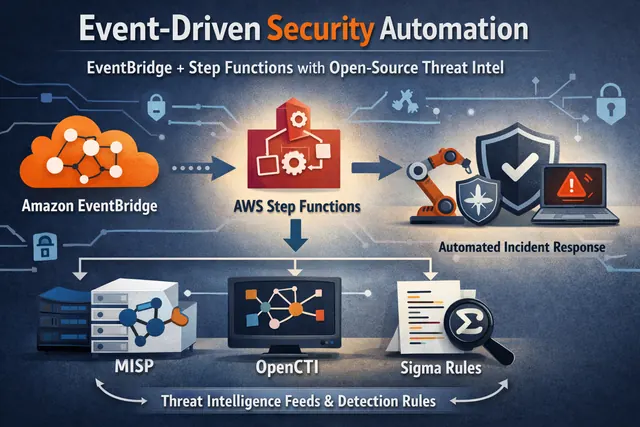
- Event-Driven Security Automation: EventBridge + Step Functions with Open-Source Threat Intel
- SBOM + Supply Chain Security: Syft, Grype, and AWS Inspector
- Security Observability with OpenTelemetry and AWS
- AWS DevSecOps Pipeline Security Automation: Complete Implementation Guide
Additional Resources
Official Documentation
- National Vulnerability Database - CVE enrichment, CVSS data, references, and vulnerability metadata
- CISA Known Exploited Vulnerabilities Catalog - Public catalog of vulnerabilities known to be exploited in the wild
- FIRST CVSS - Common Vulnerability Scoring System documentation
- AWS Security Hub - Aggregation and prioritization for AWS security findings
Tools and Frameworks
- OpenVEX - Machine-readable vulnerability exploitability exchange format
- CycloneDX VEX - VEX support for communicating affected and not-affected status
- Grype - Open-source vulnerability scanner for container images and filesystems
- OSV - Vulnerability database focused on open-source ecosystems
Conclusion
Vulnerability intelligence is valuable when it changes decisions. NVD gives you baseline metadata. CISA KEV gives you a fast signal for known exploitation. Scanner outputs tell you where vulnerable components may exist. Internal context tells you whether the issue is reachable, important, owned, and fixable.
The winning pattern is not “more feeds.” It is a context-rich prioritization system that turns vulnerability data into focused remediation work without exhausting the people responsible for fixing it.
If you are building a vulnerability-intelligence program or refining how security context reaches engineering teams, connect through jonprice.io for practical cloud security and DevSecOps guidance.